

Description
PrymaLab · Research Use Only
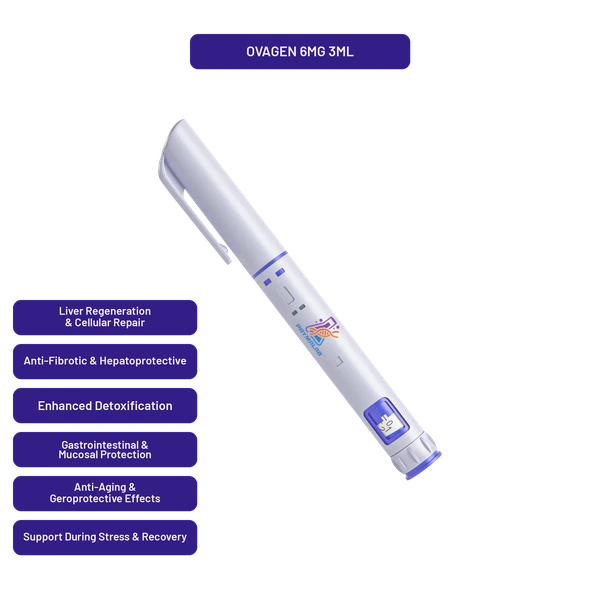
Preloaded Autoinjector | Ovagen | 3ml Pen | 6mg
Glu-Asp-Leu tripeptide in solution · 3ml at 6/3 mg/ml · No reconstitution step
The Ovagen pen is a preloaded 3ml research device holding the tripeptide Glu-Asp-Leu in solution at 6/3 mg/ml, giving 6mg in total. At 375.38 daltons it is one of the smallest molecules sold in this format, and it carries no residue that absorbs above 220 nm, which removes the usual ultraviolet check on what is in the cartridge.
Specification Table
| Property | Value |
|---|---|
| Device format | Preloaded autoinjector pen, glass cartridge |
| Fill volume | 3 ml |
| Concentration | 6/3 mg/ml |
| Total compound in device | 6 mg |
| Molar concentration | (6/3) / 375.4 x 1000 mM. A 20 mg fill gives 17.8 mM |
| Compound | Ovagen, Glu-Asp-Leu tripeptide (EDL); laboratory code T-35 |
| CAS number | None assigned. PubChem CID 444128 and ChEBI:137252 carry no CAS; vendor-quoted numbers are unverified |
| Molecular formula | C15H25N3O8 |
| Molecular weight | 375.38 g/mol average; 375.164 monoisotopic |
| Amino acid sequence | Glu-Asp-Leu, free N-terminus and free C-terminal acid |
| Solution appearance | Not published on the product record. Confirm against certificate of analysis |
| Reconstitution required | None. Supplied as solution |
| Excipient system | Not published on the product record. Confirm against certificate of analysis |
| Solution pH | Not published on the product record |
| Storage | 2-8°C, protected from light, do not freeze |
| Light sensitivity | Low for the peptide itself. No chromophore above 220 nm; light protection is precautionary |
| Solution stability | No published study of this tripeptide in solution exists |
| Net charge at pH 7 | Approximately minus 3. Calculated pI 2.8 to 3.2 |
| Degradation routes to rule out | N-terminal pyroglutamate, Asp2 isomerisation, diketopiperazine cleavage releasing leucine |
| Salt form | Acetate per vendor listings; acetate content is necessarily small given three carboxyl groups. Unverified per lot |
| Purity | Per lot-specific certificate of analysis |
| Regulatory status | No approval by FDA, EMA, PMDA, TGA or Health Canada in any jurisdiction |
What Changes When Ovagen Ships in Solution?
Three reactions are available to this tripeptide in water, and all three are quiet: none of them changes colour, none of them produces a precipitate, and two of them are invisible to a mass spectrometer read carelessly.
Begin with what cannot happen. Glu-Asp-Leu contains no methionine or cysteine, so oxidation and disulfide chemistry are off the table. It contains no asparagine or glutamine, so side-chain deamidation, the most common single failure mode in peptide solutions, has no substrate. It contains no tryptophan, tyrosine, phenylalanine or histidine, so there is no aromatic ring to photo-oxidise and no absorbance above 220 nm. That last absence is convenient chemically and inconvenient analytically, and the second half of this page returns to it.
The first available route is pyroglutamate formation. Glutamate at the N-terminus can cyclise onto its own backbone nitrogen, releasing water and losing 18 daltons to give pGlu-Asp-Leu. The reaction is slow at neutral pH, accelerates with heat and acid, and destroys the free N-terminal amine, so amine-reactive labelling chemistry stops working on the cyclised material while the solution still looks intact by eye.
The second is aspartate at position two. Manning and colleagues set out the mechanism in their 2010 review: the aspartate side chain attacks the backbone to form a succinimide, which reopens as either normal aspartate or the beta-linked isoAsp isomer. With leucine following rather than glycine or serine, the rate is moderate. The isomer has exactly the same mass as the parent, so no mass measurement will ever distinguish them. The Asp-Leu bond is also the most acid-labile in the molecule, which matters if the unpublished formulation pH turns out to be low.
The third is specific to very short peptides. Diketopiperazine formation cyclises the first two residues into a six-membered ring and cleaves off the third, so a solution of this compound can slowly become a mixture of cyclo(Glu-Asp) and free leucine. The reaction runs fastest when proline or glycine occupies those positions, which is not the case for Glu-Asp, so the rate should be slower. Slower is not zero, and free leucine at 131 daltons is the fragment a stability-indicating method would look for.
Physical behaviour is the least worrying part. With three carboxyl groups against one amine the calculated isoelectric point is 2.8 to 3.2, so at any working pH between 4 and 7 the molecule carries about three negative charges and is thoroughly hydrophilic. Aggregation and fibrillation are not expected for a 375 dalton triply anionic peptide and none has been reported. Adsorption to glass or polypropylene should be low for the same reason, though nobody has measured it. No approved product of this compound has ever been formulated, so there is no regulatory precedent to reason from.
What Is Known About Ovagen Solution Stability?
Nothing has been measured. Searches of PubMed, Crossref and Springer in September 2026 returned no forced-degradation work, no shelf-life data and no formulation study on EDL in any presentation.
Every statement about ovagen solution stability on this page therefore rests on residue chemistry rather than on data from this material. A study worth running would quantify four species: the parent, pGlu-Asp-Leu at minus 18 daltons, isoAsp-containing material resolved chromatographically rather than by mass, and free leucine as the marker of ring closure.
Nothing here says the product degrades quickly. It says nobody has checked, and that accepting a solution rather than a powder means accepting an unquantified variable in exchange for the convenience.
Does Ovagen Come in a Pen?
Yes. The question “does ovagen come in a pen” is answered by this device: a 3ml preloaded autoinjector holding 6mg of the tripeptide already in solution, alongside the more familiar lyophilized vial and an intranasal presentation.
One warning belongs with that answer. Ovagen has been the trade name of a veterinary ovine follicle-stimulating hormone preparation from ICPbio in New Zealand since at least the 1980s, used for superovulation in sheep, goats and cattle, and documented by McNatty and colleagues in the New Zealand Veterinary Journal in 1989. That product is a gonadotrophin, not a tripeptide. Search results and supplier catalogues mix the two regularly, so the molecular weight of 375.38 and the sequence Glu-Asp-Leu are the fields to check on any certificate of analysis. Background on the wider Khavinson family sits in the research overview of peptide bioregulators and in the guide to this tripeptide.
What Does the Ovagen Pen Deliver Per Increment?
The device holds 6 mg in 3 ml, so concentration is 6/3 mg/ml and each 0.01 ml graduation carries 6/300 mg. Because the molecule is small, the molar figures are unusually large for a given mass.
Molar concentration is (6/3) divided by 375.4 and multiplied by 1000 to give millimolar. At a 20 mg fill that is 6.67 mg/ml and 17.8 mM. One 0.01 ml graduation then carries 66.7 micrograms, which is 178 nanomoles, and 0.1 ml carries 667 micrograms or 1.78 micromoles. Put the other way round, 1 mg of this compound is 2.66 micromoles, so a 20 mg device holds about 53 micromoles of peptide.
The published work is nowhere near those quantities. The Khavinson kidney-culture abstracts do not state an EDL concentration, and comparable organotypic experiments in that group’s papers typically add peptide at 10 to 100 nanograms per millilitre, which for a 375 dalton molecule is roughly 27 to 270 nanomolar. Reaching 100 nanomolar from 17.8 millimolar is a 178,000-fold dilution. Nothing in the literature corresponds to a milligram quantity of this tripeptide given by any route, and the dilution calculator is the sensible place to work the series out.
Ovagen Pen vs Vial: Which Format Fits the Work?
The ovagen pen vs vial decision turns on whether the work needs many equivalent draws from one lot or needs the material to stay dry until the day of use, and on stability grounds the dry option is the safer one.
A device removes the reconstitution step and everything that goes wrong inside it: diluent volume error, incomplete dissolution, shear, adsorptive loss on transfer. It fixes concentration once, at manufacture, which removes preparation as a between-session variable.
Against that, a lyophilized vial of the same tripeptide keeps it out of water until it is needed, and all three degradation routes above require water. For a compound with no published stability data, starting the clock at the fill line is a real cost. The general argument sits in the pen and vial comparison and the other devices on the preloaded autoinjector category page. Where route rather than quantity is the variable, an intranasal preparation of the same peptide exists.
Ovagen Pen Storage and What It Guards Against
Store at 2-8°C, in the dark, without freezing. Two of those three instructions have a mechanism behind them for this molecule and one is precautionary, which is worth stating plainly rather than blurring together.
Refrigeration is the one that does real work. Pyroglutamate formation, aspartate isomerisation and diketopiperazine closure are all thermally driven. Ovagen pen storage at room temperature between sessions is the fastest way to accumulate all three products at once. The instruction against freezing is also mechanistic: freezing concentrates solutes into the shrinking unfrozen fraction and shifts local pH, and both the aspartate and pyroglutamate routes are pH-sensitive. Light protection is the precautionary one. With no chromophore above 220 nm the peptide itself is not photosensitive, so the reason to keep the device in its carton is the excipient system and the container rather than the molecule.
What the Product Record Does Not State
Five fields are missing, and for a compound with no chromophore the salt form is more consequential than usual.
Total strength is not stated, which is why this page carries 6 rather than a number. Excipient system: not published on the product record. Confirm against certificate of analysis. Solution pH: not published on the product record, and since the aspartate route runs fastest under acid conditions, that number changes how the storage instructions read. Appearance and fill date are also absent.
Beyond those, ask about the counterion. Vendor listings describe an acetate salt, and with three carboxyl groups against a single amine the acetate content is necessarily small, which means any residual trifluoroacetate from preparative chromatography makes up a proportionally larger share of the non-peptide mass. Since this compound cannot be quantified by ultraviolet absorbance, a mass-balance figure that includes counterion and water is the only honest route to knowing how much peptide the cartridge actually holds.
Verifying an Ovagen Pen Without a Chromophore
The absence of an aromatic residue is the single biggest practical difference between this compound and most of the catalogue: absorbance at 280 nm, the standard first check on a peptide solution, returns nothing useful here.
What remains is workable but less casual. Detection at 210 to 220 nm reads the peptide bond rather than a side chain, which responds to almost every organic species in the sample, so the chromatography has to do the separating. Evaporative light scattering and charged aerosol detection avoid the chromophore problem entirely and give a mass-proportional signal. Mass spectrometry identifies the parent at 375.4, finds pyroglutamate as a minus 18 satellite and free leucine at 131 as the diketopiperazine marker. What it cannot see is isoAsp, which weighs the same as the parent and needs a separation method or an enzymatic isoaspartate assay.
Device checks are the ordinary ones. Inspect each draw against a white card for clarity and particulate, allow the cartridge to reach ambient temperature before actuating so viscosity does not change delivered volume, and verify delivered mass gravimetrically once. Record the fill date and the date of first actuation, because with no stability data those intervals are the only stability information the experiment will have.
What the EDL Literature Actually Reports
Every peer-reviewed study of this tripeptide located in this search is a kidney study, which sits awkwardly with the way the compound is marketed as a liver and gastrointestinal peptide.
The in vitro record is the largest part. Khavinson and colleagues reported in Bulletin of Experimental Biology and Medicine in 2014, volume 157, pages 261 to 264, that EDL under the laboratory code T-35 acted on MMP-14 expression in primary kidney cell cultures during in vitro ageing, while the related tripeptide AED and a calf-kidney polypeptide complex acted on Ki-67 and p53. Chalisova and colleagues followed in 2015, volume 159, pages 124 to 127, with kidney explants from young and old rats in which EDL and AED stimulated proliferation and reduced apoptosis, less strongly than the polypeptide complex.
The animal record is a single paper. Zamorskii and colleagues reported in Advances in Gerontology in 2019, volume 9, pages 75 to 80, that in old rats the kidney polypeptide complex and the tripeptides AED and EDL increased diuresis by 1.2 to 1.4 fold and reduced urinary protein by 1.5 to 2.8 fold. The abstract states no dose and no vehicle.
Human evidence does not exist: no clinical trial, no case series and no registration number. There is also no pharmacokinetic measurement in any species, no toxicology, no injectable-route safety study and no replication outside the St Petersburg Institute of Bioregulation and Gerontology and its collaborators in Chernivtsi. Tripeptides of this size are expected to be hydrolysed by plasma and renal peptidases within minutes, but that has never been tested on EDL. A sister tripeptide with a comparable evidence profile is covered on the Livagen product page.
Safety and Regulatory Position
No regulator has approved this compound anywhere. It appears in no FDA Orange Book entry and in no EMA, PMDA, TGA or Health Canada register, and in Russia the Khavinson companies sell it as a dietary-supplement capsule rather than a registered injectable, a status recorded here as unverified.
It was not among the seven peptides reviewed by FDA’s Pharmacy Compounding Advisory Committee on 23 and 24 July 2026 under Federal Register document 2026-07361, published on 16 April 2026, where the only entry from this peptide family was Epitalon. It is not named on the readable FDA 503A or 503B bulk-substance category lists. With no USP monograph, no place on the 503A bulks list and no status as a component of an approved drug, it is ineligible for compounding in the United States. WADA does not name it individually; section S0 is the clause that catches non-approved substances.
No adverse findings have been reported for this tripeptide, and no systematic toxicology has been published, so the first statement follows from the second rather than standing on its own. Supply is restricted to laboratory research, and the device is not offered for use in humans or animals.
Ovagen Tablets and the Ovagen Peptide Are Two Different Products
Search results for this name mix two unrelated things, and the difference matters before anything else on this page is read. Ovagen is also the brand name of a clomifene citrate tablet marketed in India by Walter Bushnell. That product is a prescription medicine for ovulation induction. This device holds Glu-Asp-Leu, a three-residue research peptide with no relationship to it beyond the shared trade name.
That active ingredient, spelled clomiphene in United States labelling, is a selective oestrogen receptor modulator. It blocks oestrogen feedback at the hypothalamus, which raises gonadotropin-releasing hormone pulses, which raises output from the pituitary gland, which recruits a follicle. That is a well-characterised mechanism with sixty years of clinical use behind it, and it is the mechanism people are describing when they discuss Ovagen tablets and ovulation. EDL does none of this.
The indications attached to the tablet belong to the tablet. The tablet is prescribed for anovulatory female infertility, including infertility in women with polycystic ovary syndrome, and PCOS is where most of its current use sits. Treatment is timed to the menstrual cycle: the approved labelling specifies five days beginning on or about day five, while a day two to day five start is common clinical practice rather than a labelled instruction. Metformin is often prescribed alongside it in women with insulin resistance. None of this describes a laboratory research peptide, and none of it should be carried across.
The adverse effect profile belongs to the tablet as well. Approved labelling lists hot flushes in United Kingdom wording and hot flashes in United States wording, along with nausea, vomiting, headache, abdominal discomfort and ovarian enlargement. Ovarian enlargement and, at the severe end, ovarian hyperstimulation are documented risks that require monitoring. Blurred vision and other visual disturbances are the reason the label instructs prescribers to stop treatment and refer, because they can persist. Vaginal bleeding, breast tenderness and mood change also appear. Contraindications include liver disease or a history of liver dysfunction, undiagnosed abnormal uterine bleeding, ovarian cysts not caused by polycystic ovary syndrome, pregnancy, hormone-dependent tumours, uncontrolled thyroid or adrenal dysfunction, intracranial lesions such as pituitary tumour, and significant visual disturbance from previous courses. Kidney disease is not mentioned in either the United Kingdom or United States labelling, despite appearing in patient-facing summaries. Breastfeeding is a caution rather than a prohibition: the label advises care in a nursing woman because the drug may reduce lactation, and its presence in breast milk is not established.
Read that paragraph as an entity description, not as a product claim. Every symptom in it is documented for a licensed medicine that this device does not contain. The peptide in this pen has no reported effect on ovulation, hormonal balance, flushing or any endpoint listed above, because nobody has run the studies that would show one either way.
What Is Ovagen the Bioregulator Supposed to Be?
Within Khavinson’s programme, Ovagen is the liver-assigned member of the short peptide bioregulator family, and the tripeptide EDL was synthesised as a defined stand-in for a liver tissue extract. That assignment is where its claimed activity comes from. It is not a reproductive compound in that programme either, which makes the fertility vocabulary attached to the name doubly misplaced.
Evidence for the tripeptide is limited to a small body of work from the originating institute, chiefly reports of changes to gene expression and to biochemical markers after toxic liver insult in rodents. No independent laboratory has replicated the central findings, no pharmacokinetic study exists in any species, and no clinical trial of the synthetic peptide has been registered anywhere. Any bioregulator claim for this molecule is a claim about a research programme rather than about an established mechanism.
Published Literature
Every citation below was matched against its publisher record or index entry before listing. The device format itself has no literature at all.
- Khavinson VKh. Peptides, genome, aging. Adv Gerontol. 2014;4(4):337-345. DOI: 10.1134/S2079057014040134
- Khavinson VKh, Lin’kova NS, Polyakova VO, et al. Peptides regulate expression of signaling molecules in kidney cell cultures during in vitro aging. Bull Exp Biol Med. 2014;157(2):261-264. DOI: 10.1007/s10517-014-2540-y
- Chalisova NI, Lin’kova NS, Nichik TE, et al. Peptide regulation of cells renewal processes in kidney tissue cultures from young and old animals. Bull Exp Biol Med. 2015;159(1):124-127. DOI: 10.1007/s10517-015-2906-9
- Zamorskii II, Shchudrova TS, Zeleniuk VG, et al. The influence of peptides on the morphofunctional state of kidneys in old rats. Adv Gerontol. 2019;9(1):75-80. DOI: 10.1134/S207905701901017X
- Khavinson VK, Popovich IG, Linkova NS, et al. Peptide regulation of gene expression: a systematic review. Molecules. 2021;26(22):7053. DOI: 10.3390/molecules26227053
- Manning MC, Chou DK, Murphy BM, et al. Stability of protein pharmaceuticals: an update. Pharm Res. 2010;27(4):544-575. DOI: 10.1007/s11095-009-0045-6
- McNatty KP, Hudson NL, Gibb M, et al. Superovulation and embryo recovery in goats treated with Ovagen and Folltropin. N Z Vet J. 1989;37(1):27-29. DOI: 10.1080/00480169.1989.35543
Frequently Asked Questions
What is the Ovagen pen?
A preloaded 3ml research device holding the tripeptide Glu-Asp-Leu in solution at 6/3 mg/ml, giving 6mg in total, with no reconstitution step. It is supplied strictly for laboratory research. No regulator has approved this compound in any jurisdiction, and no human study of it exists.
Does Ovagen come in a pen as well as a vial?
Yes. This 3ml preloaded autoinjector holds the tripeptide already in solution, alongside the lyophilized vial and an intranasal presentation. The device fixes concentration at manufacture and removes reconstitution, at the cost of starting the degradation clock at the fill line rather than on the day of the experiment.
Which reactions can this tripeptide undergo in water?
Three. N-terminal glutamate can cyclise to pyroglutamate, losing 18 daltons and the free amine. Aspartate at position two can isomerise to isoAsp through a succinimide intermediate, with no mass change. Diketopiperazine formation can cyclise the first two residues and release free leucine at 131 daltons.
Which common degradation routes does this sequence rule out?
Oxidation and deamidation, the two most common routes in peptide solutions. There is no methionine or cysteine, so no thioether oxidation or disulfide chemistry, and no asparagine or glutamine, so no side-chain deamidation. There is also no aromatic residue, so nothing photo-oxidises.
Has Ovagen solution stability ever been measured?
No. September 2026 searches of PubMed, Crossref and Springer found no forced-degradation, shelf-life or formulation study of EDL in any presentation. What appears on this page is inference from residue chemistry, which is a reasonable basis but is not the same thing as a measured shelf life for this product.
What does one 0.01 ml increment deliver?
6/300 mg, which at a 20 mg fill is 66.7 micrograms or 178 nanomoles. A 0.1 ml movement gives 6/30 mg, so 667 micrograms or 1.78 micromoles at that fill. Molar concentration is (6/3) divided by 375.4 then multiplied by 1000, giving 17.8 mM for a 20 mg device.
How far is the device from the concentrations used in the published work?
Far. Comparable organotypic experiments add peptide at roughly 10 to 100 nanograms per millilitre, about 27 to 270 nanomolar for a 375 dalton molecule. Reaching 100 nanomolar from 17.8 millimolar is a 178,000-fold dilution, and no published study used a milligram quantity of this tripeptide by any route.
Ovagen pen vs vial: which is the safer choice for stability?
The vial, on stability grounds alone, because all three degradation routes need water and a lyophilized cake keeps the peptide out of it until the day of use. The device wins on reproducibility instead, fixing concentration once and removing four separate sources of reconstitution error.
What does Ovagen pen storage require?
2-8°C, dark, no freezing. Refrigeration is the instruction doing real work, since all three degradation routes are thermally driven. Freezing shifts local pH as solutes concentrate into the unfrozen fraction. Light protection is precautionary here rather than mechanistic, because the peptide has no chromophore.
Why is this compound harder to verify than most peptides?
Because it has no residue absorbing above 220 nm. Absorbance at 280 nm, the standard first check on a peptide solution, returns nothing. Quantitation has to fall back on peptide-bond detection at 210 to 220 nm, on evaporative light scattering or charged aerosol detection, or on mass spectrometry.
What mass changes signal degradation here?
Minus 18 daltons from the 375.4 parent indicates pyroglutamate formation. Free leucine appearing at 131 daltons indicates diketopiperazine closure. The isoAsp isomer produces no mass change whatsoever, so it needs a chromatographic separation or an enzymatic isoaspartate assay rather than a spectrometer.
Why does the salt form matter more for this molecule?
Because it cannot be quantified by ultraviolet absorbance, so the peptide content has to come from a mass balance that accounts for counterion and water. With three carboxyl groups against one amine the acetate content is necessarily small, which makes any residual trifluoroacetate a proportionally larger share of the non-peptide mass.
Is this the same Ovagen used in veterinary breeding work?
No, and the collision is a genuine source of confusion. Ovagen has been the trade name of an ovine follicle-stimulating hormone preparation from ICPbio in New Zealand since the 1980s, documented by McNatty and colleagues in 1989. That product is a gonadotrophin. Check for molecular weight 375.38 and the sequence Glu-Asp-Leu.
Is this a liver peptide?
The marketing says so; the literature does not. Every peer-reviewed study of EDL found in this search concerns kidney tissue: renal cell cultures, kidney explants and renal function in old rats. No published liver, hepatocyte or gastrointestinal study of this tripeptide was located.
What is the only animal study?
Zamorskii and colleagues, Advances in Gerontology 2019, volume 9, pages 75 to 80. In old rats a kidney polypeptide complex and the tripeptides AED and EDL increased diuresis 1.2 to 1.4 fold and reduced urinary protein 1.5 to 2.8 fold. The abstract gives neither dose nor vehicle.
Is there any human or pharmacokinetic data?
None of either. No clinical trial, case series or registration number exists for this compound, and no measurement of absorption, distribution, half-life or clearance has been made in any species. Peptides of this size are expected to be cleared by plasma and renal peptidases within minutes, but that has never been tested here.
What is the regulatory position?
Unapproved everywhere and ineligible for compounding in the United States, having no USP monograph, no place on the 503A bulks list and no status as a component of an approved drug. It was absent from the seven peptides FDA’s Pharmacy Compounding Advisory Committee reviewed on 23 and 24 July 2026.
Is this the same Ovagen as the fertility tablet?
No. Ovagen is also the brand name of a clomifene citrate tablet marketed in India by Walter Bushnell, a prescription medicine used for ovulation induction. This device holds the tripeptide Glu-Asp-Leu and shares nothing with it except the trade name. The two products have different molecules, different mechanisms and different legal status.
How does clomifene work, and does this peptide do the same thing?
Clomifene, spelled clomiphene in United States labelling, is a selective oestrogen receptor modulator that blocks oestrogen feedback at the hypothalamus, raising gonadotropin output from the pituitary gland and recruiting a follicle. It is prescribed for anovulatory female infertility, commonly in polycystic ovary syndrome, and often alongside metformin. EDL has no such mechanism and no reported effect on the menstrual cycle.
Do the side effects listed for Ovagen tablets apply to this peptide?
No. Hot flushes, nausea, vomiting, headache, ovarian cysts, vaginal bleeding and visual disturbances including blurred vision are documented for the clomifene tablet, which also carries a contraindication in liver disease and a caution in breastfeeding because it may reduce lactation, with its presence in breast milk not established, while kidney disease appears in patient summaries rather than in the labelling. Those findings belong to a licensed medicine that this device does not contain.
What is Ovagen supposed to be within the Khavinson programme?
The liver-assigned member of the short peptide bioregulator family, synthesised as a defined stand-in for a liver tissue extract. It is not a reproductive compound in that programme either. The evidence is a small body of rodent and cell work from the originating institute with no independent replication, no pharmacokinetics and no registered clinical trial.
Compliance Statement
The Ovagen autoinjector is sold exclusively for laboratory research use. It is not a drug, food, or cosmetic product, and it is not a dietary product of any kind. It is not approved by the FDA or any comparable authority for human or veterinary use. This product is not intended to diagnose, treat, cure, or prevent any disease. It must not be given to humans or animals. Purchase is restricted to qualified researchers and institutions operating within applicable laws. All handling is the responsibility of the purchasing laboratory.










Reviews
There are no reviews yet.